


Have you ever heard of daith piercing or tragus piercing as a solution for migraines? Many people seek relief from their pain, especially when you know that nearly 15% of the population suffers from migraines, with a majority of women and even children affected. However, no solid scientific evidence guarantees the effectiveness of these piercings, even though thousands of testimonials circulate online. Some report a marked improvement after trying a daith piercing, while others notice no change. This phenomenon is intriguing, and you are not alone in asking questions.
Key Points
Daith piercing and tragus piercing are placed on specific areas of the ear, often chosen for their unique style and their popularity among people suffering from migraines.
These piercings could work by stimulating the vagus nerve, which helps calm the pain, but no solid scientific evidence confirms their effectiveness against migraines.
Many testimonials report an improvement in migraines after the piercing, but this effect may come from the placebo effect, which strongly influences perception.
Scientific studies on these piercings remain rare, with limited results and risks of bias, which prevents them from being considered an official treatment.
Before getting started, it is important to know the risks of infection or rejection, to choose an experienced professional, and to always consult a doctor to find the best solution.
Daith and tragus piercing: overview
Location and description
You are probably wondering exactly where these piercings are located on the ear. Daith piercing and tragus piercing are not placed just anywhere. Each has a very specific location, and that is what makes them unique.
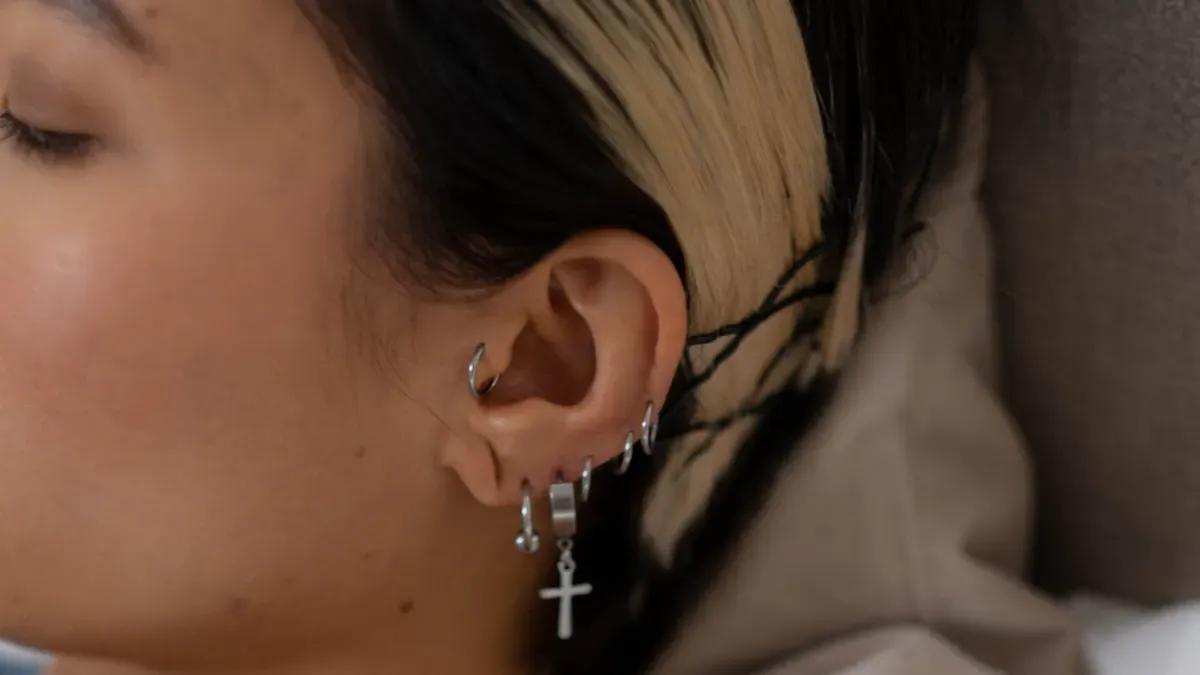
Daith piercing is placed in the deep fold of the inner cartilage of your ear. This little corner is often difficult to see, but it draws attention with a well-chosen piece of jewelry.
Tragus piercing, on the other hand, is located on the small cartilaginous area just in front of the ear canal. You can easily spot it by touching the part that covers the entrance to your ear.
These locations give each piercing a distinctive look. You can choose different jewelry depending on the shape of your ear and your style. Many people like the discreet or original aspect of these piercings.
Popularity among migraine sufferers
You may notice that daith piercing and tragus piercing are becoming increasingly popular among people who suffer from migraines. Several reasons explain this phenomenon:
Their unique aesthetics attract those who want to stand out or add a personal touch to their look.
The anatomical position on the cartilage allows for wearing varied jewelry, which appeals to many people.
Anecdotal beliefs circulate about their potential to relieve migraines. Even though nothing is scientifically proven, some testimonials encourage trying a daith piercing to see if it helps.
Tip: If you are considering a daith piercing, take the time to carefully choose the jewelry and the professional. The location requires a precise technique to avoid complications.
You see, these piercings are not just a matter of fashion. They also carry the hope of relief for those seeking alternative solutions for migraines.
Supposed mechanisms of daith piercing
Acupressure point and vagus nerve
You are probably wondering why daith piercing attracts so much attention among people who suffer from migraines. Many believe that this piercing acts as a form of acupressure. When you place a piece of jewelry in this specific area of the ear, it exerts pressure on the cartilage. Some experts suggest that this pressure could stimulate the vagus nerve, an important nerve for regulating pain and calming the nervous system.
The pressure of the jewelry could stimulate the vagus nerve, which helps balance the autonomic nervous system.
This mechanical stimulation is supposed to relieve headaches by calming migraine attacks.
The vagus nerve can reduce inflammation and promote relaxation, which could indirectly influence the frequency of migraines.
Techniques such as meditation or deep breathing also stimulate this nerve, but daith piercing offers a permanent approach.
There are reputed acupressure points for relieving migraines, such as GB20 (at the base of the skull) or Hegu (between the thumb and index finger), but the real acupuncture point related to migraines is located about 1 cm from the piercing, which calls its effectiveness into question.
You should know that daith piercing does not cure migraines. It may simply reduce their intensity in some people.
Possible placebo effect
You may have heard testimonials from people who feel an improvement after getting this piercing. Neurologists remind us that no solid clinical evidence supports these claims. The relief felt could come from a powerful placebo effect.
Many report a reduction in the frequency or intensity of their migraines after the piercing.
The effects felt can be explained by contextual factors or the placebo effect.
No randomized or controlled study has documented a reduction in migraines related to daith piercing.
Improvement stories exist, but they do not constitute generalizable evidence.
Serious content states that no study has validated the benefits of daith piercing for migraines.
Note: If you are hoping for a miracle, keep in mind that the experience varies from one person to another. The placebo effect often plays an important role in this type of alternative solution.
Scientific evidence and studies
Research results
You probably want to know what studies say about daith piercing and migraines. Research remains rare, but a few results draw attention. Several people who chose this piercing report an improvement in their symptoms. In more than 90% of cases, participants report a complete stop of migraines. An assistant, who suffered from severe headaches, saw her pain disappear after getting the piercing. She still feels the onset of headaches, but the pain no longer settles in as before. Studies specify that the piercing does not cure the underlying disease. It mainly helps to reduce the associated headaches.
You also notice that the majority of research focuses on daith piercing. A few case studies report improvements in some patients. Specialized reviews insist that this data is not enough to establish the piercing as a validated treatment. Scientists remain cautious. Scientific data on the effectiveness of daith and tragus piercings for treating migraines are limited.
You find a lot of testimonials online, but clinical studies remain few. The results are encouraging for some, but they do not guarantee a solution for everyone.
Limitations of current data
You should know that studies on daith piercing have several limitations. Researchers have not conducted controlled and randomized studies. The sample sizes remain small, which makes the results less reliable. They often lack control groups or double-blind protocols. These weaknesses make it difficult to interpret the results. The risks of bias related to the placebo effect are significant. Many people feel an improvement simply because they believe in the power of the piercing.
Here are the main limitations of current studies:
Absence of controlled and randomized studies
Small sample sizes
Lack of control groups or double-blind
Risks of bias related to the placebo effect
You now understand why there is no scientific consensus on the effectiveness of daith or tragus piercing against migraines. The data remain limited and the results do not allow this piercing to be validated as an official treatment.
Before getting started, take the time to consult a healthcare professional. Studies do not yet prove the actual effectiveness of daith piercing for migraines.
Testimonials and experiences
Positive feedback
You probably want to know what people who tried the experience think. Many share their stories on social media or in discussion groups. Some say they have seen their migraines decrease after getting a daith piercing. Others explain that they feel more relaxed, which helps reduce stress-related migraine attacks. You can also read testimonials from migraine sufferers convinced that this piercing has changed their daily lives.
Here is what you can often find in testimonials:
Several people say they stopped taking their migraine medications after the piercing.
Many notice a significant drop in the frequency and intensity of their headaches.
About 70% of participants in an online survey report an improvement after the piercing.
More than 70% of people maintain a positive opinion even a year later.
In some cases, migraines disappear completely.
For others, the pain becomes much more bearable.
You can see that the enthusiasm is real among those who had a good experience. Some finally feel relieved after years of suffering.
Negative feedback and bias
But not everyone experiences the same thing. You will also find people who see no change, or who feel an improvement only at the beginning. Experts believe that the placebo effect plays a major role. If you believe the piercing will work, you can feel real relief, even without scientific evidence.
Here are a few points to keep in mind:
The felt benefits often come from the placebo effect.
The conviction of getting a positive result greatly influences perception.
No acupuncturist has confirmed the effectiveness of the piercing against migraines.
There is no solid scientific evidence to validate daith piercing as a treatment.
Don't forget: every experience is different. What works for one does not always work for another. Take the time to think carefully before getting started.
Risks and precautions
Possible complications
You probably think that daith or tragus piercing is simple, but there are risks not to be underestimated. You can encounter medical complications, especially if you do not follow the care or if the piercer lacks experience.
Excessive redness, swelling, or persistent pain can signal an infection.
A discharge of pus or a fever should alert you quickly.
Sometimes, the skin around the piercing becomes very thin. This phenomenon indicates a rejection of the jewelry.
Do you feel constant itching or discomfort? This can also be a sign of rejection.
The healing time varies depending on the location and your anatomy. You must remain vigilant for several weeks.
Tip: Always monitor the evolution of your piercing. If you notice a worrying change, consult a healthcare professional without delay.
Tips before getting started
Before deciding, take the time to think about several criteria. You must choose an experienced piercer and think about the piercing location, the pain, the healing time, and the risks of infection.
Avoid alcohol or substances that dilate blood vessels before the piercing. This minimizes the pain.
Clean the piercing twice a day with a sterile saline solution.
Never touch the piercing with unwashed hands.
Avoid cosmetic products and perfumes near the pierced area.
Follow the post-piercing care for optimal healing.
Monitor signs of infection such as increased pain, redness, or abnormal secretions.
You should also think about the cost of the piercing and its maintenance. Here is a table to help you:
Piercing type |
|
|---|---|
Daith |
40 - 100 |
Tragus |
30 - 50 |
Don't forget: always consult a healthcare professional before getting started. They will help you assess the risks and choose the best option for you.
Comparison with other treatments
Classic medical treatments
When you seek relief from your migraines, you often find classic solutions recommended by doctors. These treatments are tested and validated. You can use them to calm the pain or prevent attacks. Here is what specialists most often offer:
Paracetamol 1g: You can take it as soon as the migraine starts.
Paracetamol + caffeine 500/50 mg: This combination sometimes helps reinforce the effect of the medication.
NSAIDs (such as ibuprofen, ketoprofen, or naproxen): These anti-inflammatories relieve pain well.
Aspirin 1g: Many migraine sufferers use it too.
Preventive treatments: If you have frequent migraines, your doctor can prescribe propranolol, metoprolol, or topiramate.
Other therapies: You can try relaxation, biofeedback, or cognitive and behavioral therapies to better manage stress.
Tip: Always talk with your doctor before changing treatment or starting a new one.
Advantages and limitations of piercings
You're probably wondering why some migraine sufferers prefer to try a daith or tragus piercing. Many see these piercings as an alternative to medication. They hope for an effect similar to acupuncture, as the jewelry is placed on a specific point on the ear. Some say they feel more relaxed, less stressed, and have fewer attacks after getting the piercing. Others notice an improvement in their energy levels.
But be careful, piercings are not suitable for everyone. Results vary greatly from person to person. You should also know the limitations and risks:
Piercing type |
Acupuncture point |
Associated risks |
|---|---|---|
Daith |
Headaches |
Avoid if you often have headaches |
Tragus |
Tension, anxiety |
May disrupt your sleep or increase your stress |
Remember: Piercing is not a miracle cure. Take the time to think carefully and observe how your body reacts after getting it.
You see, no solid evidence confirms that a daith or tragus piercing really relieves migraines. Specialists do not recommend this method, as you risk infections or complications. Before you go ahead, talk to a healthcare professional. To summarize:
The piercing may act on the vagus nerve, but nothing has been proven.
The risks remain real: infection, allergy, difficult healing.
Conventional treatments remain safer and validated.
Take care of yourself and choose the solution best suited to your case!
FAQ
Does a daith piercing really relieve migraines?
You'll find many testimonials, but no scientific evidence confirms the effectiveness of a daith piercing. You may experience a placebo effect. Always talk to your doctor before going ahead.
Does a tragus piercing help with migraines?
You can try a tragus piercing, but studies do not show reliable results. Some people feel an improvement, others do not. You should remain cautious and consult a healthcare professional.
What are the main risks?
You risk infection, jewelry rejection, or difficult healing. Keep a close eye on your piercing and ask a specialist for advice if you notice any worrying signs.
How long does it take to heal?
You should wait between 4 and 12 weeks for complete healing. Clean your piercing every day. Avoid touching the area with dirty hands.


