


Do you want to avoid pain, irritation, or infections after a piercing? The choice of jewelry bar directly affects your skin's health. Many people experience discomfort because they didn't take the time to choose the right bar. Look at the risks associated with a poor choice:
Risk |
Estimated frequency |
Description |
|---|---|---|
Bacterial infection |
5-15% |
Redness, pain, purulent discharge |
Keloids |
2-5% |
Thick scar growths |
Allergic reaction |
Variable |
Itching, eczema, swelling |
You can limit these problems by paying close attention at every step to choose the right bar.
Key Points
Choose an ASTM F136 titanium bar to avoid allergies and promote fast healing.
Take into account the length and thickness of the bar for optimal comfort and to avoid irritation.
Opt for internally threaded or threadless bars for comfortable wear, especially at night.
Avoid materials containing nickel to prevent allergic reactions and infections.
Always consult a professional to choose the bar suited to your body type and situation.
Why the piercing bar is essential
Impact on comfort
The comfort of your piercing depends heavily on the bar you choose. If you wear a suitable bar, you will experience less discomfort in your daily life. Health professionals recommend certain materials for their softness and lightness.
Titanium is hypoallergenic.
Its lightness prevents the feeling of weight on the skin.
A smooth surface reduces friction and limits the risk of irritation.
You will quickly notice the difference between a quality bar and a low-end bar. A poor bar can cause pain or redness from the very first days.
Role in healing
The bar directly influences the healing of your piercing. A good material, such as titanium, promotes fast healing. The smooth surface prevents bacteria from clinging on. This helps you avoid complications such as infections or keloids. If you choose a bar that is too short or too long, the area can swell or become infected more easily.
Prevention of irritation
Do you want to avoid itching or allergic reactions? Prioritize the materials recommended by experts:
Medical Teflon (PTFE)
Avoid jewelry containing nickel or cheap metals. These materials often cause allergies or irritation. A good choice protects your skin and makes wearing the piercing pleasant.
Structure and material
The structure of the bar also plays a key role. A well-designed bar adapts to the shape of your ear or skin. The material must be safe and tested. ASTM-F136 titanium remains the standard for the initial placement. Medical PTFE also offers a good alternative for very sensitive skin.
Tip: Always ask your piercer what material they use before placement.
A good choice of bar allows you to enjoy your piercing without worry, every day.
The different types of piercing bars
Do you want to choose the ideal bar? Discover the main types of piercing bars. Each has its advantages and limitations. Here is how to recognize and use them.
Classic stud (straight bar)
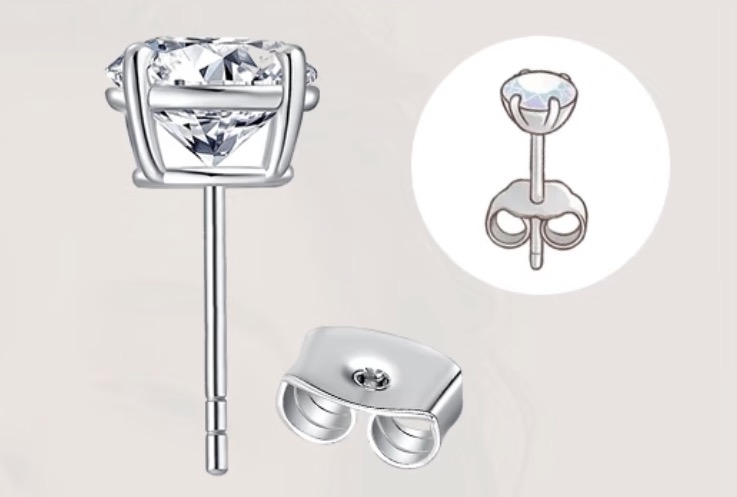
The classic stud remains the simplest model. You recognize it by its straight shape and its small ball at the end.
Advantages:
Easy to insert and remove.
Ideal for earlobes or first piercings.
Disadvantages:
Can move during the night.
Risk of falling out if the ball is not properly screwed on.
Tip: Choose this type if you want a discreet piece of jewelry that is easy to handle.
For whom?
You are just starting out or you want a piercing that is simple to maintain.
Threadless (THREADLESS)
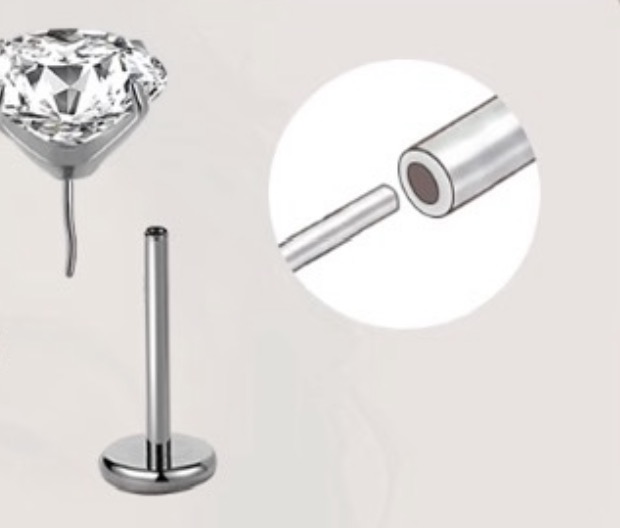
The threadless bar, also called "push-in", works without a screw. You simply insert the decorative part into the bar.
Advantages:
No risk of injury caused by threading.
Quick jewelry change.
Disadvantages:
Requires good pressure to secure properly.
Can loosen if you pull on it.
For whom?
You want to change jewelry often or you have sensitive skin.
Internal threading (labret)
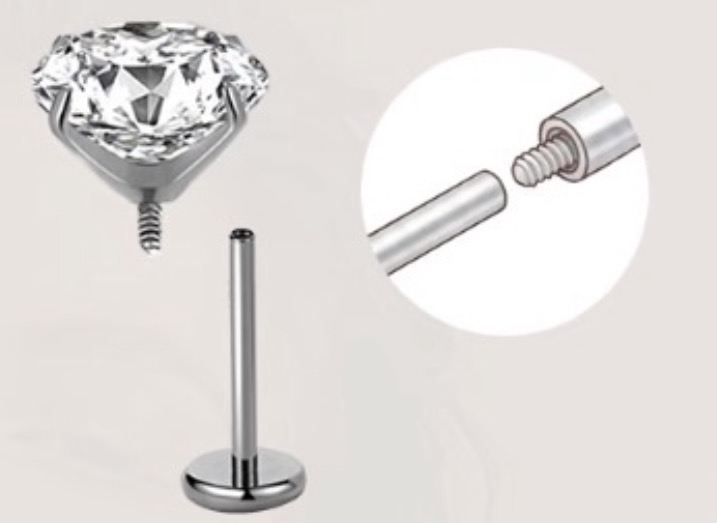
The internally threaded labret has a hollow bar. You screw the decorative part inside.
Advantages |
Disadvantages |
|---|---|
Smooth, soft surface |
Sometimes more expensive |
Less irritation |
Requires a suitable piece of jewelry |
For whom?
You are looking for comfort and safety, especially for a new piercing.
External threading
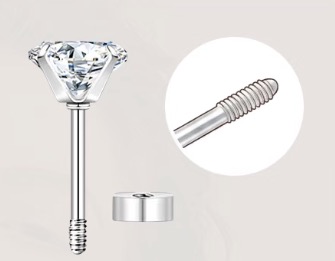
External threading features the screw on the outside of the bar.
Advantages:
Often lower price.
Wide choice of models.
Disadvantages:
Threading can irritate the skin during insertion.
Less recommended for healing.
Note: Prioritize this type for already healed piercings.
For whom?
You already have a well-healed piercing and you want to vary the styles.
How to choose the right bar according to your situation
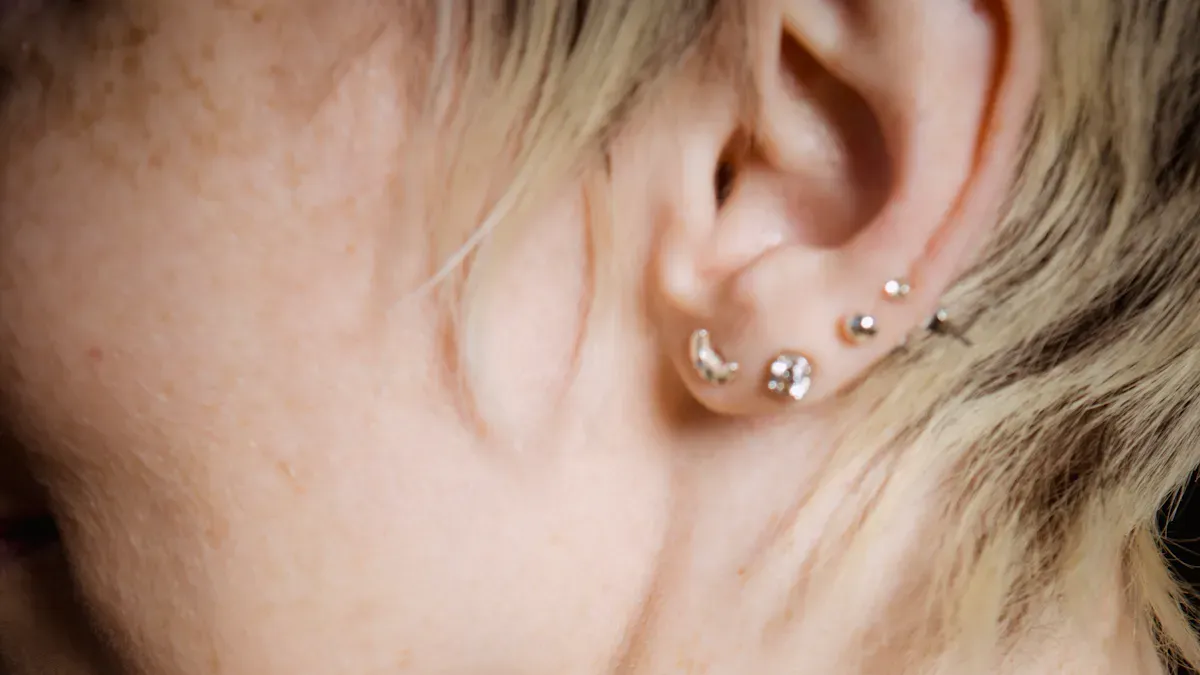
New piercing
Have you just gotten pierced? To choose the right bar, you must take into account several essential criteria. The length of the bar is measured without the ball or the base plate. The most common sizes are 6 mm, 8 mm, and 10 mm. A bar that is too short can compress the skin and slow down healing. A bar that is too long moves too much and increases the risk of irritation. The diameter of the ring influences the final look. For a fit close to the lobe, professionals recommend a diameter between 6 and 12 mm.
Tip: Always ask your piercer to measure the area precisely before choosing the right bar.
You promote fast healing and avoid complications.
Sensitive ears
Do you have sensitive ears? To choose the right bar, you must prioritize hypoallergenic materials. Experts recommend ASTM-F 136 titanium. This material is light, resistant, and does not cause allergies. 316LVM surgical steel remains an affordable option, but it must be guaranteed nickel-free. 18-karat gold also works, but avoid white gold, which often contains nickel. Borosilicate glass is an alternative for delicate piercings.
ASTM-F 136 Titanium
Nickel-free 316LVM surgical steel
18-karat gold (no white gold)
-
Borosilicate glass
Tip: If you react to certain metals, choose the right titanium bar to limit the risks.
Daily wear and night
Do you want to keep your piercing day and night? To choose the right bar, you must think about comfort and safety. Internally threaded or threadless bars are ideal. They have a smooth surface that does not hurt the skin during sleep. Labret models ensure good stability and avoid friction.
Prioritize a light bar
Smooth surface
-
Internal threading or threadless
Note: A suitable bar allows you to sleep without discomfort and wear your jewelry with complete peace of mind.
Small budget
Is your budget limited? You can choose the right bar without sacrificing safety. 316LVM surgical steel remains affordable and reliable, provided it is nickel-free. Titanium bars are sometimes more expensive, but they offer better tolerance. For small budgets, always check the material certification.
Material |
Estimated price |
Tolerance |
|---|---|---|
Surgical steel |
€ |
Good |
ASTM-F 136 Titanium |
€€ |
Excellent |
18-karat gold |
€€€ |
Very good |
Tip: Do not choose a low-end bar. This helps you avoid irritation and infections.
Sports and active life
Do you play sports or move around a lot? To choose the right bar, you must prioritize safety. Experts recommend internal threading Its shape ensures better hold during physical activities. This type of bar minimizes the risks of displacement and comes in several designs.
Nostril screw for optimal fixation
Curved bar
-
Several styles available
Tip: If you practice a regular sports activity, choose the right bar that stays well in place.
Don't forget: For each situation, consult a professional. They adapt the size and material to your body type. You avoid mistakes and enjoy a comfortable and safe piercing.
Criteria for choosing the right bar
Length and thickness
To choose the right bar, it is essential to know the length and thickness suited to your pierced area. The length of the bar, often called a "stud" or "labret", must allow optimal comfort without compressing the skin. In general, for a new piercing, a bar between 6 mm and 8 mm is suitable, as it leaves enough space for the initial swelling. If you have a thicker nostril or piercing, it may be wise to opt for a slightly longer length.
The thickness of the bar, also called "thickness", should be between 0.8 mm and 1 mm. A bar that is too thin can cause irritation or bend, while a bar that is too thick risks being uncomfortable. The precise measurement of the pierced area is crucial. For this, use a caliper or ask your piercer to measure the area precisely.
For rings, the standard diameter varies between 6 mm and 8 mm. A diameter of 6 mm offers a tight effect, ideal for a discreet look, while 7 or 8 mm give a fuller look.
Hypoallergenic material
The choice of material is decisive for choosing the right bar. ASTM F136 titanium remains the standard for the initial placement, because it is biocompatible, hypoallergenic, and resistant to corrosion. It is less likely to cause allergic reactions, unlike certain gold alloys or surgical steel that may contain nickel.
ASTM F136 titanium is considered the safety standard for piercings, guaranteeing optimal healing. Its lightness and durability make it an ideal choice to avoid irritation and promote fast healing.
Adaptation to anatomy
Each person has a unique body type. It is therefore crucial to adapt the bar to your anatomy. A bar that is too short can compress the skin, slowing down healing, while a bar that is too long can lead to friction and irritation.
For this, measure the pierced area precisely. If you have a nose piercing, for example, the length must allow a slight space for swelling without being too loose. The shape of the bar must also follow the natural curve of your skin or cartilage.
Don't forget that for the initial placement, it is strongly recommended to use an ASTM F136 titanium bar. This material guarantees optimal compatibility with your body, reducing the risk of allergic reaction and facilitating healing.
In summary, to choose the right bar, you must take into account the length, thickness, material, and adaptation to your body type. A precise measurement and a quality material will ensure you lasting comfort and peaceful healing.
Errors to avoid
When you choose or wear a piercing bar, certain errors can put your health at risk. Here are the most common pitfalls to avoid to keep your piercing healthy and comfortable.
Sleeping with a bad piece of jewelry
Sleeping with an unsuitable piece of jewelry can cause many problems. Dermatologists often observe these consequences in people who neglect this point:
Infections
Allergic reactions
Tip: Always choose a smooth, lightweight bar that is right for your body type for sleeping. This reduces the risk of irritation or injury.
Bar too short or too long
An ill-fitting bar interferes with healing. If you choose a bar that is too short, the skin is compressed, which can cause swelling and pain. A bar that is too long moves too much, which can irritate the pierced area and slow healing. Take the time to measure the area correctly before buying your jewelry.
Wrong material
The choice of material directly affects the health of your piercing. Some materials should be avoided to limit allergic reactions:
Acrylic (PMMA): well tolerated but not recommended for the initial piercing.
Other non-hypoallergenic materials.
Tip: Always opt for ASTM F136 titanium or another hypoallergenic material for the initial piercing.
Poor hygiene
Poor hygiene exposes your piercing to serious complications. Medical statistics show that you risk:
Hemorrhagic complications, especially in sensitive areas
Slow healing, which can lead to thick scars or keloids
Clean your piercing regularly with a suitable solution. This protects your skin and promotes healthy healing.
Avoiding these mistakes helps you enjoy your piercing without worry and preserve your health in the long term.
Why choose an ASTM F136 titanium piercing
The choice of material for your piercing bar directly affects the health of your skin and the success of healing. ASTM F136 titanium is the standard for ensuring safety and comfort. Discover why this material makes a difference.
Hypoallergenic and nickel-free
Want to avoid allergic reactions? ASTM F136 titanium perfectly meets this need. This material contains no nickel, a common allergen in standard jewelry. Clinical studies show that ASTM F136 titanium remains completely inert. It does not react with your body and thus limits the risk of allergy or irritation.
ASTM F136 titanium contains no nickel.
It does not cause a reaction with the skin.
It reduces the risk of allergies, even in sensitive people.
Tip: If you have already had a reaction to jewelry, always choose an ASTM F136 titanium bar for the initial piercing.
Lightweight and resistant
Everyday comfort also depends on the weight and strength of your bar. ASTM F136 titanium has a lightweight structure. You will almost forget you are wearing jewelry. Its strength protects your piercing from impacts and deformation, even if you lead an active life.
Lightweight, it does not weigh down the skin.
Strong, it does not deform easily.
Durable, it retains its new appearance for a long time.
Note: Lightweight jewelry reduces discomfort and promotes rapid healing.
Ideal for sensitive skin
Dermatologists recommend ASTM F136 titanium for sensitive skin. Its medical composition limits unwanted skin reactions. You can wear your piercing without fearing redness or itching.
Suitable for reactive skin.
Lower risk of redness or eczema.
Suitable for everyone, even children or people with allergies.
ASTM F136 titanium therefore offers you maximum safety and lasting comfort. You put all the odds in your favor for a healthy and worry-free piercing.
Our recommendation for your piercing
Labret with internal threading
Are you looking for safe and comfortable jewelry? The labret with internal threading remains the standard for the majority of piercings. This type of bar has hidden threading inside. This avoids any direct contact between the screw and your skin. This design reduces the risk of irritation and injury during the insertion or removal of the jewelry.
Tip: The labret with internal threading adapts very well to the shape of your ear or lip. You feel less discomfort, even in the event of repeated movements.
Professionals recommend this model for new piercings, but also for everyday wear.
F136 titanium
F136 titanium represents the ideal choice for the initial piercing. This material complies with European and medical standards. It contains no nickel and remains completely biocompatible. This limits the risk of allergy or infection.
Here is why F136 titanium makes a difference:
Its smooth surface prevents the accumulation of bacteria.
It promotes rapid healing, even on sensitive skin.
Its lightness offers optimal everyday comfort.
You enjoy durable jewelry that is easy to maintain. Recent studies confirm that F136 titanium reduces complications after a piercing.
Comfort and safety
To guarantee your comfort and safety, you must choose a bar that is right for your anatomy. Professionals insist on three essential criteria:
A certified material, such as F136 titanium.
A smooth finish to avoid irritation.
A size adjusted to your body type.
Note: Well-chosen jewelry allows you to wear your piercing without pain, day and night.
In summary, you put all the odds in your favor by opting for an F136 titanium labret with internal threading. This choice brings you safety, comfort, and peace of mind, whatever your situation.
You retain several essential points to choose your piercing bar properly:
The diameter and length of the bar must adapt to your body type.
The type of jewelry influences comfort and customization.
Hypoallergenic titanium remains the preferred material to avoid reactions.
Always consult a professional. They check the studio's hygiene, the quality of the jewelry and help you choose the right material. This allows you to enjoy a comfortable and safe piercing. Discover titanium bars, available in several sizes and adapted to all types of piercings.
FAQ
Which bar should you choose to sleep without discomfort?
You should opt for an internally threaded or threadless bar. These models have a smooth surface. This avoids friction and injury during the night. Titanium remains the most comfortable material.
Which bar should you use if you have sensitive ears?
Opt for an ASTM F136 titanium bar. This hypoallergenic material limits skin reactions. You can also choose medical PTFE or borosilicate glass if your skin reacts to certain metals.
Why does your piercing hurt?
Several causes exist: bar too short, unsuitable material, infection, or poor hygiene. Check the size and material of your bar. Consult a professional if the pain persists.
Tip: Clean your piercing every day to avoid complications.
Can you keep your piercing in all the time?
Yes, you can keep your piercing in day and night if you use a suitable bar and a safe material. Opt for titanium or PTFE for continuous wear. Always monitor the condition of your skin.


